 S31
S31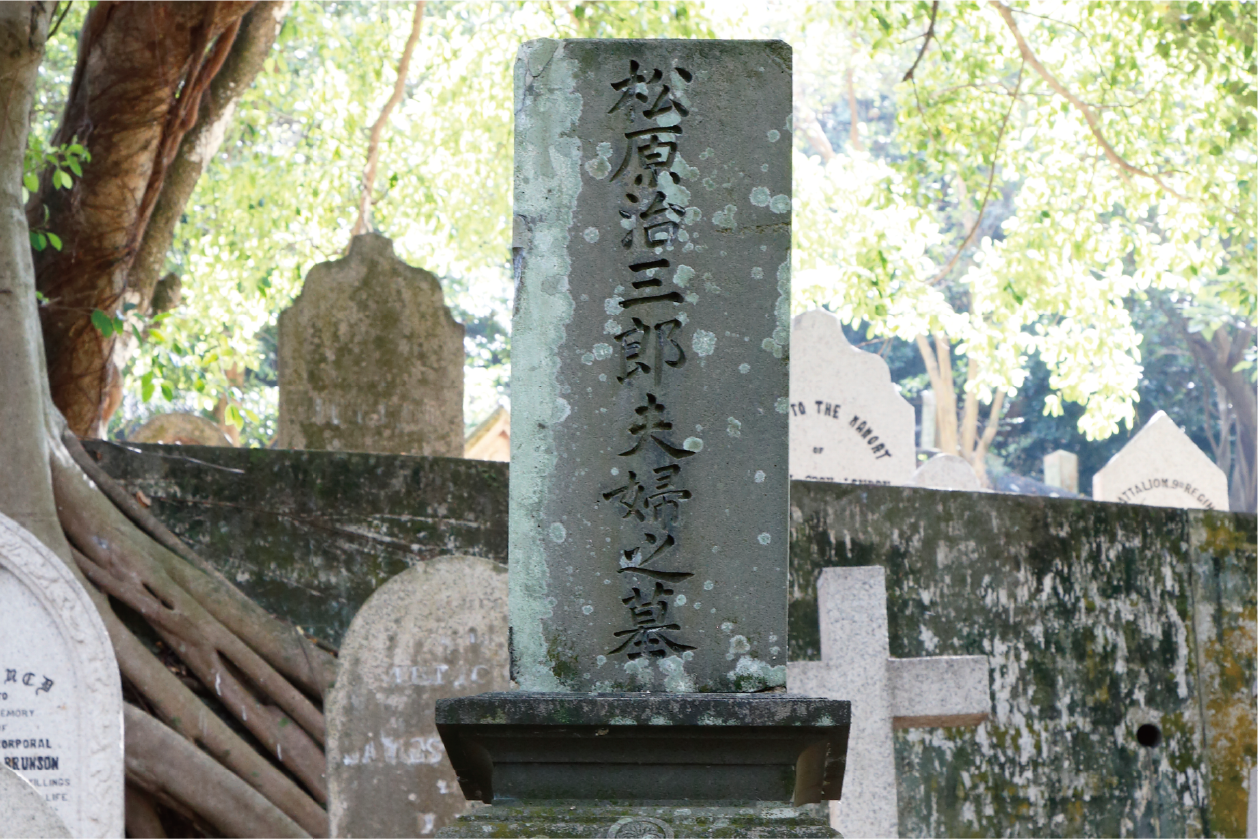
MATSUBARA Jisaburō was the owner of the Matsubara Japanese Hotel. Located at 18 Connaught Road on the Central waterfront, it opened its doors in 1905 and was one of a handful of ryokan– style inns in Hong Kong at the time. Its customers included Japanese migrant workers headed to Thursday Island, one of 274 islands that lie between the tip of the Australian state of Queensland and Papua New Guinea in the Torres Strait, to work as divers in the lucrative pearl-shell industry. It is also likely that the Matsubara Hotel was connected to the traffic of karayuki-san to other parts of
Southeast Asia, at least in the early years of the lodging house’s operation.
Amongst other frequent guests were students of the Tōa Dōbun Shoin (East Asia Common Culture Academy) in Shanghai. Inaugurated on May 26, 1901, the Shanghai Academy was an offshoot of the semi-governmental Tōa Dōbunkai (East Asia Common Culture Association). Founded three years earlier in Tokyo by Prince KONOE Atsumaro (1863-1904), the Association’s stated aims included enhancing Sino-Japanese relations, promoting trade, and countering Western ambitions in the area. Students at the Tōa Dōbun Shoin received training in both English and Chinese languages, as well as business practices and research methods, and were required to undertake extensive fieldwork throughout China. The investigation reports that the students produced were channelled to several Japanese government departments, and a number of the Academy’s graduates went on to serve in Japan’s intelligence services. These field trips, sometimes referred to as dai ryokō or “Big Trip” in the tradition of the “Grand Tour,” often took the students to Hong Kong, and their reports mention their accommodation, in the form of a large, shared tatami room, at the Matsubara ryokan.
In addition to the running of his hotel, Matsubara’s food and beverage industry skills would eventually see him put in charge of the restaurant at the premises of the recently opened Japanese residents’ club in Ice House Street. Originally developed from Yamato Kai, a Japanese association founded by two executives in 1903, the Nippon Club was officially established in 1905 with the help of a significant donation from ŌTANI Kōzui (1876-1948). Ōtani, who became the 22nd Abbot of the Jyōdoshinshū Hongwanji Temple in Kyoto in 1903, made the donation of HK$500 during his 1899 visit to Hong Kong. Jyōdoshinshū Hongwanji, commonly known as Nishi (West) Hongwanji, was, and remains, one of the largest and most influential schools of Buddhism in Japan, and facilitated the establishment of several Japanese overseas resident associations. Early membership of the Nippon Club in Hong Kong was confined to government employees, bank and shipping executives, as well as the managers of the city’s leading commercial houses. The Ice House Street premises featured games rooms, dining and reading facilities, and the Club organised numerous sports and other social activities.
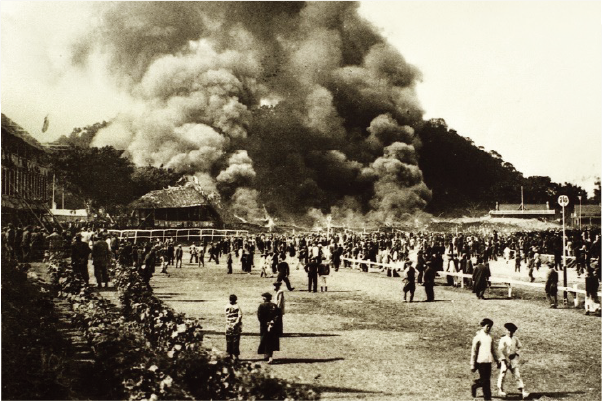
Matsubara perished in what remains one of Hong Kong’s worst human-made disasters, the Happy Valley Racecourse fire of February 26, 1918. The disaster left over 600 people dead, many burnt beyond any formal identification, including at least 13 members of the Japanese community. Matsubara was there in his capacity as chief accountant for the Japanese Benevolent Society. Established in 1890, the Society was a charitable organisation that aided the sick and those in need, including pregnant girls, and occasionally provided funds for burials and funeral ceremonies. Starting in 1909, a large portion of the Society’s revenue came from its booth at the annual “Derby Day” horse races in Happy Valley, a major date on the racing calendar with 10,000 spectators attending. The booths, which were auctioned off each year by the Department of Public Works, were temporary structures, or matsheds, made of bamboo and palm leaf matting. These were to supplement the existing permanent Grand Stand that was predominantly open to members of the Hong Kong Jockey Club and other local dignitaries.
In 1918, the Japanese Benevolent Society had successfully bid HK$1,280 for booth no. 15, and had a two-floor plus basement matshed erected from which it sold sweepstake tickets. Its matshed could hold anything up to 200 people at any one time. Due to unseasonably dry weather that February, the contractor responsible for putting up the 19 matsheds had been unable to sink the support poles firmly into the ground, a contributing factor to the sudden collapse of the comparatively flimsy structures just before the start of the fifth race. Many of the booths offered refreshments such as hot tea, and had rudimentary charcoal stoves, or chatties, for the purpose of boiling water. The falling poles and matting not only trapped the booths’ visitors, but also rapidly caught fire, burning them to death or causing them to suffocate from the fumes.
The colonial government opened an enquiry into the tragedy on March 7, with the proceedings
concluding on April 12, 1918. While no criminal negligence was attributed, the enquiry highlighted the Department of Public Works’ lack of oversight of the matshed construction process, the insufficient police presence, and the inadequacy of fire fighting provisions at the site; it also made several recommendations. As a result of the fire, the Governor, Sir Francis Henry May, permanently banned matsheds from the racecourse and ordered the building of new permanent stands.
Matsubara’s date of death is given as March 7, 1918, which indicates that he died from his injuries, rather than on the actual day of the conflagration. His age is also engraved on the headstone—54 years old. UETSUKI Kakuzō, the proprietor of the Tokyo Hotel and Sei Foo Row Annex, and principal of a provisions company, was another of the Japanese victims. A member of the Japanese Benevolent Society, he claimed that he had been recognised by the Japanese government with a medal of honour. His funeral was held on February 28 and his body cremated at the So Kon Po crematorium, which had been built by the Society in 1912 to serve the Japanese community.
On February 26, 1919, the Society unveiled a grand monument dedicated to all the victims of the fire, with a calligraphic inscription by Ōtani Kōzui. Initially situated next to the crematorium, it was moved to its present location in the Japanese section of the Hong Kong Cemetery in 1982. Another memorial to those who perished in the fire erected by the Tung Wah Hospital sits over the hill in So Kon Po, near the Hong Kong Stadium. Its original site was selected in an area known as the Coffee Garden and, with the benefit of public donations, construction on two pavilions, a memorial arch, and two pagodas started in 1922. The Race Course Fire Memorial was declared a monument on October 23, 2015, and is protected under the Antiquities and Monuments Ordinance.
The Happy Valley Racecourse fire left over 600 people dead, including at least 13 members of the Japanese community.
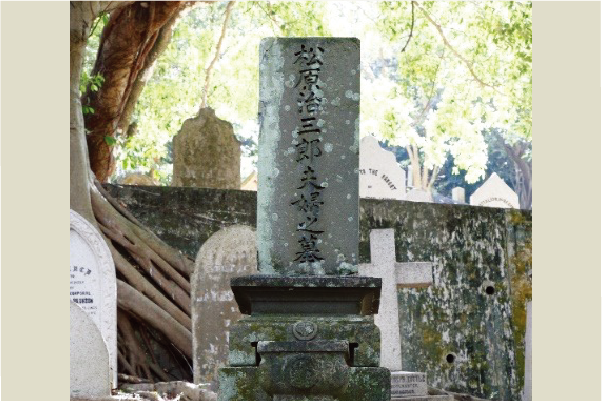
Matsubara was the owner of the Matsubara Hotel on the Central waterfront, which first opened its doors in 1905.
Lim, Patricia. 2011. Forgotten Souls: A Social History of the Hong Kong Cemetery. Hong Kong: Hong Kong University Press.
Nagata, Yuriko. 2017. “The Japanese in Torres Strait.” In Navigating Boundaries: The Asian Diaspora in Torres Strait, edited by Anna Shnukal, Guy Ramsay, and Yuriko Nagata. Australia: ANU Press.
Ng, Benjamin Wai-ming. 2005. “Making of a Japanese Community in Prewar Period (1841–1941).” In Foreign Communities in Hong Kong, 1840s-1950s, edited by Cindy Yik-yi Chu. Palgrave Macmillan.
Reynolds, Douglas R. 2014. “Training Young China Hands: Tōa Dōbun Shoin and Its Precursors, 1886-1945.” In The Japanese Informal Empire in China, 1895-1937, edited by Peter Duus, Ramon Myers, and Mark R. Peattie. Princeton, NJ: Princeton University Press.
Stockwin, Arthur, and Keiko Tamura, eds. 2016. Bridging Australia and Japan: Volume 1: The Writings of David Sissons, Historian and Political Scientist. Australia: ANU Press.
Wright, Arnold, ed. 1908. Twentieth Century Impressions of Hong Kong, Shanghai, and other Treaty Ports of China: Their History, People, Commerce, Industries, and Resources. Lloyd’s Greater Britain Publishing Company, Ltd.
Xavier, Roy Eric. 2013. “Death at the Races: The Portuguese Presence during the Happy Valley Fire of 1918.” Journal of the Royal Asiatic Society Hong Kong Branch 53: 89-107.
South China Morning Post:
February 28, 1918: The Race Course Holocaust. Death Roll Almost 600.
March 1, 1918: Racecourse Conflagration. Official Statement.
March 8, 1918: The Happy Valley Catastrophe. The Enquiry Commenced. First Day’s Evidence.
March 19, 2018: The Happy Valley Catastrophe. Eighth Day’s Proceedings.
April 13, 1918: The Happy Valley Disaster. The Jury’s Finding.