 S31
S31
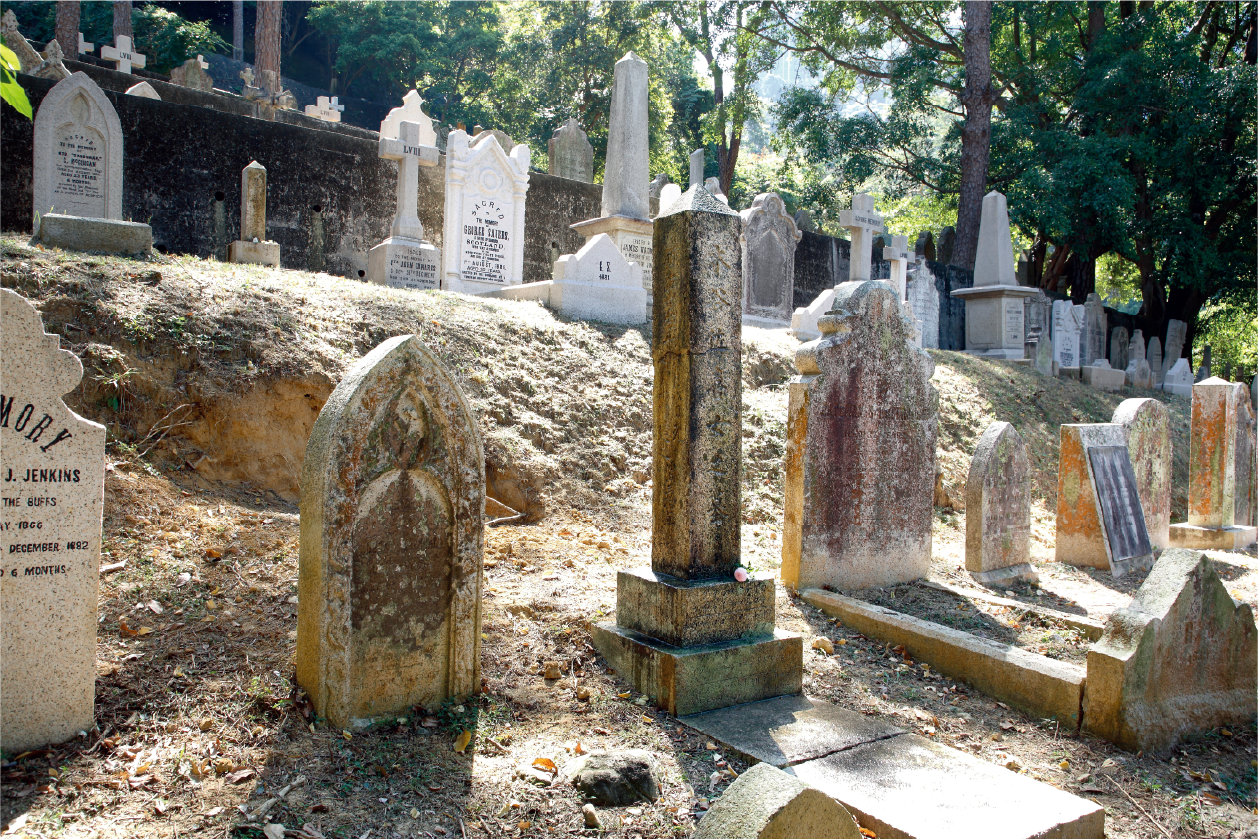
One of the most noteworthy graves in the Japanese section of the Hong Kong Cemetery belongs to a 30-year-old woman from Nagasaki named KIYA Saki, who died on June 8, 1884. The base of the obelisk-shaped headstone bears the names of 62 women in the katakana syllabary rather than the usual kanji (Chinese characters). Knowledge of the make-up of the Japanese population in Hong Kong at that time points to this being the grave of a prostitute, a karayuki-san. The headstone refers to KIYA as a “commoner,” an indication that she was not from the samurai class. While the Meiji government had been quick to abolish the four divisions of society—samurai, farmers, artisans, and merchants—to facilitate social mobility, these class distinctions persisted. Kiya’s is the oldest known grave of a woman in the Japanese section of the Cemetery and this may be the reason why the character for “woman” was, somewhat unusually, included on the obelisk. Her tomb stands tall, a clear statement that its occupant is deserving of respect. An inscription in English at the foot of the monument indicates that it was erected by her friends, and must refer to the women whose names are inscribed on her gravestone.
A report in The China Mail dated June 10, 1884, speaks of the recovery of the body of a Japanese woman, aged about 22 years, from the waters near the “East of Tsim Tsa Tsui Wharf” the previous day. The woman was fully dressed except for her shoes, which were found later, and was wearing a loose jacket into which two heavy stones had been tied. Upon further enquiries by the police, it was determined that the deceased was named Osaki and an “inmate of an immoral house” at 27 Graham Street in Central. The brothel-keeper advised that Osaki had received a letter from her family a few weeks prior informing her that her father was ill and asking her to return to Japan. Not having the
means to do so, a second letter followed a little later with the news that her father had died. At seven o’clock on June 8, 1884, a Sunday, Osaki left the house, never to return. An inquest was opened, but with no further details available, the jury returned a verdict of “found drowned.”
Women made up a large percentage of the Japanese population in Hong Kong in the late nineteenth-century. Many of them were prostitutes from the southern island of Kyushu, who came to be known as karayuki-san. Japanese consular records for 1886 put the number of Japanese residents in Hong Kong at approximately 150, with close to 100 women. Some of the women are listed as family members of Japanese men posted to the territory or as domestic helpers; there is also a shamisen player and a hairdresser. Nearly three quarters are described as working in kashi-
zashiki (rental rooms), a euphemism for prostitution, and “cafés,” or as concubines of Western men. Several of the women whose names appear on Kiya’s grave are included in this list, with a few recorded as being from Nagasaki and domiciled at 27 Graham Street. This along with the name— “O” is a prefix frequently used in Japanese—and date of death, leaves us in little doubt that Kiya Saki is the woman whose tragic end is recounted in The China Mail article.
The colonial government’s push to develop Hong Kong into a major trading port meant that the city was home to a growing number of predominantly male, transient workers, both Chinese and foreign. This population of soldiers, sailors, merchants, manual labourers, construction workers, and domestic servants created a demand for female sex workers, mostly from China, but also from other nations, including Japan. The Meiji government’s opening up of the country and greatly enhanced maritime transportation links facilitated the traffic of Japanese women to Hong Kong, China, as well as other parts of the British Empire in Southeast Asia, including Singapore and Malaya.
Many of the early Japanese sex workers in Hong Kong were uneducated young girls from the rural parts of Kyushu, more specifically from the Amakusa Islands (Kumamoto prefecture), and Shimabara Peninsula near Nagasaki. In addition to the area’s paucity of natural resources, inhabitants faced further hardship due to their embrace of Christianity during the Tokugawa Shogunate (1600-1868). Their unsuccessful revolt against high taxation known as the Shimabara- Amakusa Rebellion in 1637-1638 forced their beliefs underground and caused them to be subject to unfavourable policies and discrimination that added to their already desperate circumstances.
The installation of the Meiji government in 1868, lifting of the ban on Christian worship and the surveillance that it had engendered, and further opening of the port of Nagasaki, particularly for the export of coal, encouraged many in Amakusa and Shimabara to leave and find work overseas. The term karayuki-san, literally “person travelling overseas,” initially applied to both male and female migrant workers; only later was it used to exclusively reference female sex workers. Whilst it has been argued that some women and girls left with the full knowledge of the nature of their work in Hong Kong, the vast majority, at least in the late nineteenth-century, were most likely tricked into believing that they would be employed as servants or shop assistants, abducted, or sold by their families to brokers.
Hong Kong’s nineteenth-century colonial government was predominantly concerned with regulating the Chinese sex industry, as a further means of policing the territory’s Chinese population, and with limiting the spread of venereal disease within the non-Chinese community. In 1857, it introduced an “Ordinance for checking the spread of venereal diseases,” which required
brothels to be registered and, initially all, but later only prostitutes catering to non-Chinese customers to be subjected to a weekly examination by a Western doctor. This classification of establishments along racial lines into those catering to Chinese customers and those catering to non- Chinese customers would endure until the 1930s. Japanese brothels seem to have been comparatively less policed, with the colonial government paying lip service only to pleas from Japanese consular officials to regulate Hong Kong’s karayuki-san.
In 1885, Hong Kong had eight licensed Japanese brothels with 52 prostitutes, and undoubtedly several unlicensed operations. Japanese prostitutes provided sexual services to mainly working- class residents of various nationalities, and visiting sailors and merchants. Most licensed Japanese brothels in the 1880s were located in Central, in the areas around Stanley Street, Hollywood Road, Graham Street, and Cochrane Street. The karayuki-san were part of an underground economy that benefitted not only the procurers who had arranged their passage from Japan, but also corrupt harbour officials, seamen, and other petty officials involved in their traffic. Furthermore, a whole local industry of small retailers, food stall owners, shopkeepers, tailors, kimono sellers, and hairdressers grew up around them and relied on their and their brothel’s custom to prosper.
When a karayuki-san was sold to a brothel, she was expected to take on the price paid for her by the brothel-keeper as a “debt,” which had to be paid off. Most of her earnings, therefore, went towards covering this “debt,” as well as any other daily expenses she incurred, such as food and lodging.
This effectively left many karayuki-san bound to their brothels for years, and once they had made remittances to their families in Japan, there was little left for their own future security. While some karayuki-san did eventually return to their hometowns, enjoy relatively more comfortable lives as concubines, or become brothel-keepers themselves, a significant number ended up sick and destitute, and died without ever seeing Japan again. Of the approximately 470 graves in the Japanese section of the Cemetery, over two hundred are identified by a plot number rather than a name. Among them may well be the resting places of karayuki-san who, like Kiya Saki, never left Hong Kong.
The character for “woman” is clearly visible on Kiya Saki’s obelisk
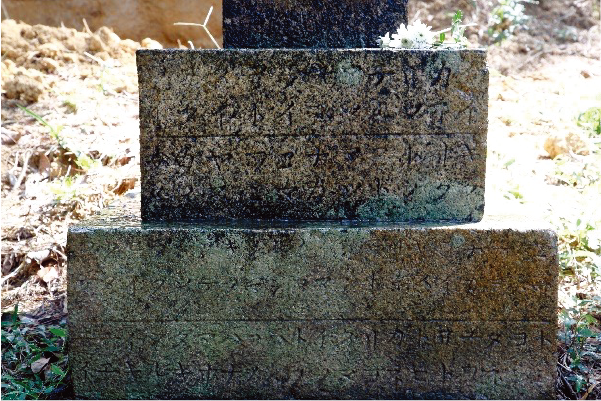
The names of the 62 friends who erected Kiya Saki’s tombstone.
Howell, Philip. 2004. “Race, Space and the Regulation of Prostitution in Colonial Hong Kong.”
Urban History 31 No. 2: 229-248.
Lim, Patricia. 2011. Forgotten Souls: A Social History of the Hong Kong Cemetery. Hong Kong: Hong Kong University Press.
Mihalopoulos, Bill. 2001. “Ousting the ‘Prostitute’: Retelling the Story of the Karayuki-san.” Postcolonial Studies: Culture, Politics, Economy 4, No. 2: 169-187.
Ng, Benjamin Wai-ming. 2005. “Making of a Japanese Community in Prewar Period (1841– 1941).” In Foreign Communities in Hong Kong, 1840s-1950s, edited by Cindy Yik-yi Chu. Palgrave Macmillan.
Shimizu, Hiroshi. 1997. “Karayuki-san and the Japanese Economic Advance into British Malaya, 1870–1920.” Asian Studies Review 20, No. 3: 107-132.
Sinn, Elizabeth. 2007. “Women at Work: Chinese Brothel Keepers in Nineteenth-Century Hong Kong.” Journal of Women’s History 19 No. 3: 87-111.
Warren, James Francis. 1993. Ah Ku and Karayuki-san: Prostitution in Singapore 1870-1940. Singapore: Oxford University Press.
Yamazaki, Tomoko. 1999. Sandakan Brothel No. 8: An Episode in the History of Lower-class Japanese Women. Translated by Karen Colligan-Taylor. Armonk, NY; London: M.E. Sharpe.
Yonekura, Seiichiro, and Hiroshi Shimizu. 2012. “Entrepreneurship in Pre–World War II Japan: The Role and Logic of the Zaibatsu.” In The Invention of Enterprise: Entrepreneurship from Ancient Mesopotamia to Modern Times, edited by David S. Landes, Joel Mokyr, and William J. Baumol, 501-526. Princeton, NJ: Princeton University Press.
The China Mail, June 10, 1884.
The China Mail, June 13, 1884.