The Hong Kong Cemetery, which was originally known as the Protestant Cemetery and then the Colonial Cemetery, was officially opened in 1845. It currently contains over 7,000 recorded graves, of which approximately 470 belong to members of, or are somehow connected to Hong Kong’s Japanese community. However, the number of interments in the Cemetery is likely to have been much higher; some gravestones were lost through neglect or theft, and many graves were relocated to make way for the Aberdeen Tunnel in 1976. The Japanese initially had no burial ground of their own, and early Japanese graves can, therefore, be found scattered among those of the deceased Protestants for whom the Cemetery was established. It was not until 1910 that the British colonial government explicitly set aside sections for Christians and non-Christians within the Cemetery, thereby paving the way for the Japanese community to create a dedicated area for its graves.
Around 80% of the Japanese graves are those of civilians who died during the Meiji era (1868-1912), a remarkable period of modernisation and opening up of Japan that saw thousands of its people travel to other parts of the world and establish themselves there, including in Hong Kong. From just 13 residents recorded in 1875, the community had grown to over 1,000 by 1911. Many of the graves belong to merchants, Japanese company representatives and their family members, or sailors and students who succumbed to illness on their way to or from Japan. The oldest identifiable Japanese tomb in the Cemetery is that of a 22-year-old second lieutenant returning home after military training in France in 1878.
| Meiji Era | Male | Female | Unknown | Estimated Total | |
|---|---|---|---|---|---|
| Meiji Era | 1868-1912 | 174 | 121 | 88 | 383 |
| Post-Meiji era | 1913 | 34 | 30 | 23 | 87 |
| Estimated Total | 208 | 151 | 111 | 470 |
Women made up a large percentage of the Japanese population in Hong Kong in the late nineteenth-century. Many of them were prostitutes from the southern island of Kyushu, who came to be known as karayuki-san. The term karayuki-san, literally “person travelling overseas,” initially applied to both male and female migrant workers; only later was it used to exclusively reference female sex workers. One of the most noteworthy graves in the Japanese section of the Cemetery belongs to a karayuki-san who died in 1884. Her comparatively prominent headstone includes the names of the 62 women who erected it, but there are many more whose graves are marked by a simple stone that bears a plot number rather than a name.
he Hong Kong Cemetery lies just across the road from the Happy Valley Racecourse, which, on February 26, 1918, was the scene of what remains one of Hong Kong’s worst human-made disasters. Over 600 people, including at least 13 members of the Japanese community, lost their lives in a devastating fire that ripped through temporary structures that had been built to accommodate spectators for one of the most important dates on the racing calendar. Several of the Japanese graves belong to victims of the conflagration. On February 26, 1919, the Japanese Benevolent Society unveiled a grand monument dedicated to all those who perished in the fire, with a calligraphic inscription by ŌTANI Kōzui, the 22nd Abbot of the Nishi Hongwanji, a major school of Japanese Buddhism. Initially situated next to the Japanese Crematorium in So Kon Po, the Memorial to Ten Thousand Souls was moved to its present location in the Japanese section of the Hong Kong Cemetery in 1982.
The colony’s sanitary conditions in the late nineteenth century were poor and disease was rife. Malaria, cholera and smallpox were all endemic, and “fever” was a major cause of death. Hong Kong had its first major outbreak of plague in 1894 and the disease would remain an issue for the next twenty-five years. The city’s hygiene gradually improved at the beginning of the twentieth century, however, and it became more common for Japanese expatriates to be accompanied by their families and raise their children in Hong Kong. This all came to a halt with the Japanese invasion of Hong Kong in December 1941 and Japan’s subsequent occupation of the colony. Upon Britain’s resumption of authority over Hong Kong in August 1945, any Japanese citizens remaining in the territory were ordered to leave. They would not start returning until the early 1950s; the Japanese Consulate reopened its doors in 1952 and the Bank of Tokyo established its Hong Kong Branch in 1953.
The Japanese section of the Hong Kong Cemetery does not contain memorials to any Japanese soldiers killed during the Second World War. With no family member to care for them, the graves were left unattended for over thirty years after the War, and only one headstone for three members of the same family has been added since 1946. In 1982, at the request of the Hong Kong government, the Hongkong Japanese Club undertook the necessary arrangements to move the Memorial to Ten Thousand Souls from So Kon Po to the Hong Kong Cemetery. This marked the beginning of the Club’s efforts to preserve the Japanese graves, and, in 1992 and 2000, with the support of the Japanese Foreign Ministry, it was able to secure the resources needed to carry out extensive restoration work.
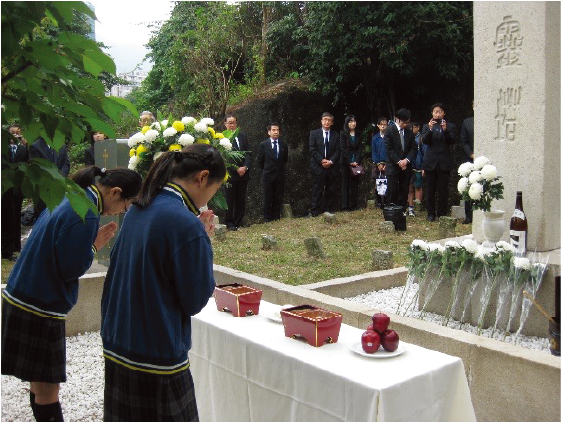
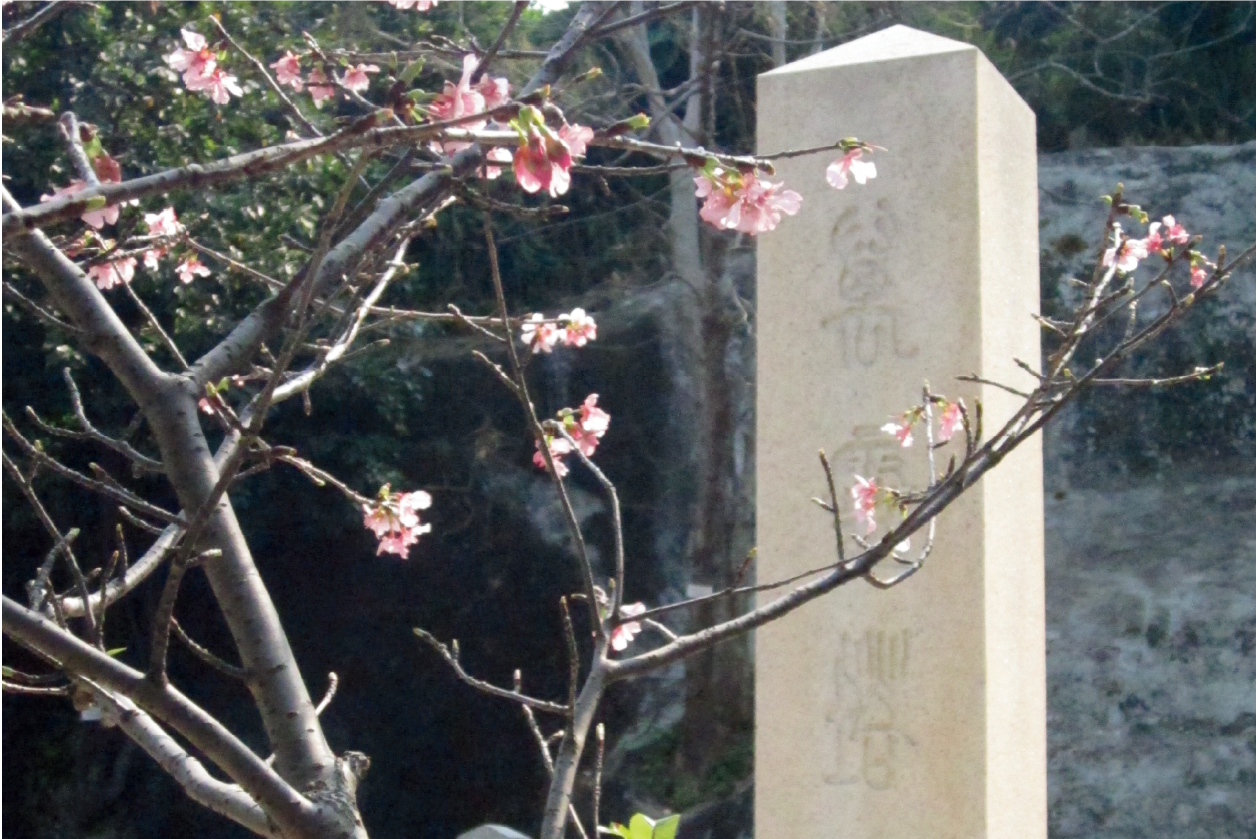
The Club eventually established a Preservation Committee and has since 2000 conducted an annual ceremony to remember these early members of the Japanese community. In August 2002, a respected Kabuki actor travelled to Hong Kong for two performances at the Hong Kong Cultural Centre. He and his wife suggested planting trees in locations important to the Japanese community, including the Cemetery. Of the original fourteen cherry blossom trees of the Kawazu-zakura variety that were planted on February 14, 2004, six remain. This planting of ornamental trees was very much in line with the colonial government’s original intentions for the Cemetery, which was envisaged as both a memorial garden and a public park, in keeping with the design of European cemeteries like the Père Lachaise in Paris.
These early graves and the stories of those who are buried in them provide us with invaluable insight into what daily life would have been like for members of the Japanese community in late-nineteenth- and early-twentieth-century Hong Kong. They allow us to rediscover events and people that might otherwise be forgotten, and offer a very personal connection to the past of this vibrant and multicultural city.
The Club conducts an annual commemorative ceremony in the Japanese section of the Cemetery.
Photo by The Hongkong Japanese Club
Ko, Tim-Keung. 2001. “A Review of Development of Cemeteries in Hong Kong: 1841-1950.”
Journal of the Royal Asiatic Society Hong Kong Branch 41: 241-280.
Lim, Patricia. 2011. Forgotten Souls: A Social History of the Hong Kong Cemetery. Hong Kong: Hong Kong University Press.
Ng, Benjamin Wai-ming. 2005. “Making of a Japanese Community in Prewar Period (1841–1941).” In Foreign Communities in Hong Kong, 1840s-1950s, edited by Cindy Yik-yi Chu. Palgrave Macmillan.
Nicolson, Ken. 2010. The Happy Valley: A History and Tour of the Hong Kong Cemetery. Hong Kong: Hong Kong University Press.
Smith, Carl T. 1985. “Notes for a Visit to the Government Cemetery at Happy Valley.” Journal of the Hong Kong Branch of the Royal Asiatic Society 25: 17-26.
Starling, Arthur, Faith C.S. Ho, Lilian Luke, Tso Shiu-chiu, and Edwin C.L. Yu, eds. 2006. Plague, SARS and the Story of Medicine in Hong Kong. Hong Kong: Hong Kong University Press.