 S31
S31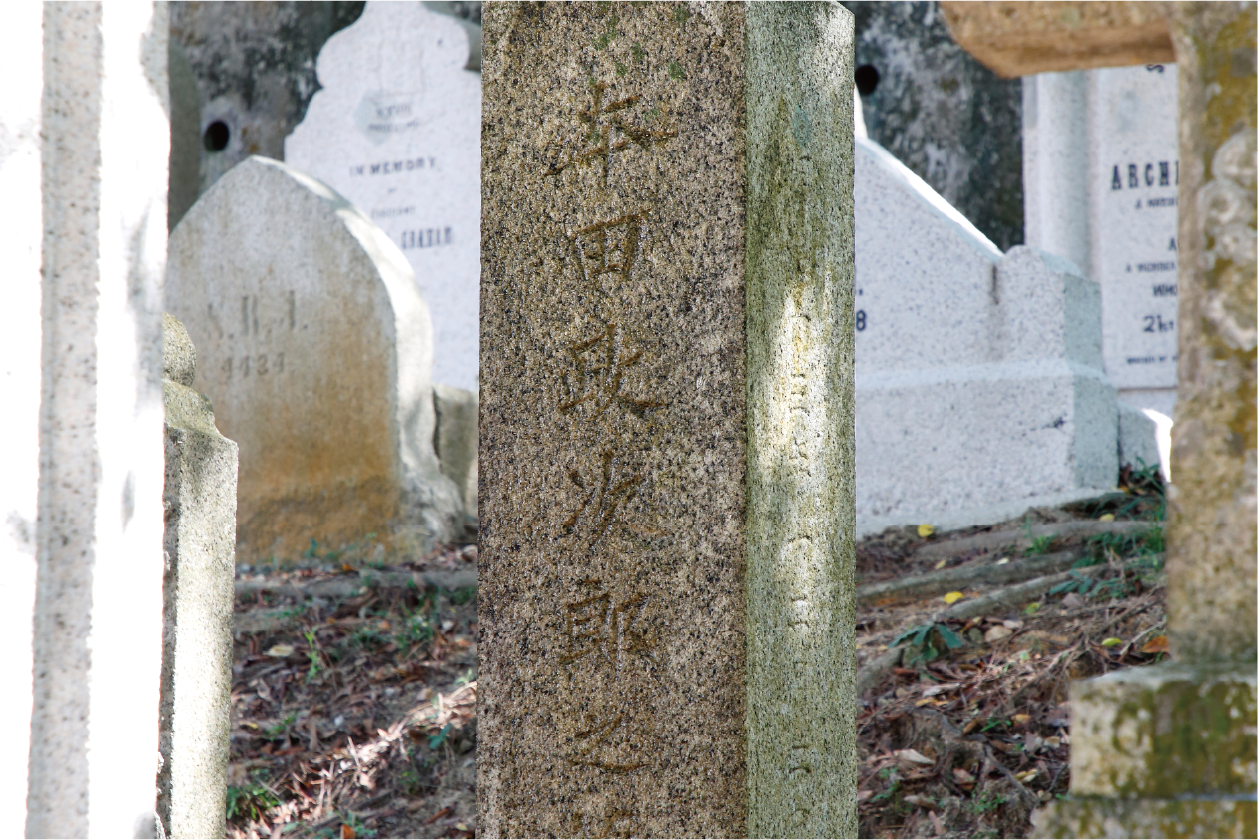
Under the leadership of IWASAKI Yatarō, the Mitsubishi Mail Steamship Company launched Japan’s first regular service overseas with a weekly operation between Yokohama and Shanghai in February 1875. The 1,096-ton Niigata-maru was one of four ships serving the route and was captained by an Englishman, Wilson WALKER (1845-1914). Both Walker and the Niigata-maru would later be involved in efforts to establish a regular service between Yokohama and Hong Kong, making the first run on October 4, 1879.
The Niigata-maru arrived in Hong Kong on October 12, 1879, amid considerable fanfare. There to welcome the inaugural sailing from Yokohama were HONDA Masajirō, Mitsubishi’s Hong Kong Office General Manager, and another company officer, MURAKAMI Hideshi. Eager to promote its business in the face of intense competition from British companies, such as the Peninsular and Oriental Steam Navigation Company (P&O), Mitsubishi organised an onboard luncheon—or tiffin—on the service’s third run.
The November 13, 1879, issue of The China Mail carried a full report of the occasion. Over 60 guests, including the Governor of Hong Kong, Sir John Pope Hennessy, were ferried out to the Niigata-maru, where they were greeted by Honda and another Mitsubishi agent, Henry John Howard Tripp. A portion of the 27th Inniskillings Regimental Band played throughout the
luncheon, in a nod to the Governor’s Irish roots. Following a toast to “The Queen,” Pope Hennessy, who was recently returned from a three-month visit to Japan, proposed a toast to “H.M. the Mikado of Japan,” adding that he believed that this was the first time the health of the Mikado had been proposed in Hong Kong. Glasses were then raised to “The Army and Navy,” “The Bar,” “The Merchants of Hongkong,” and “The Managers and Directors of the Company, and Success to the Company.” Honda made the only Japanese-language contribution, “Gentlemen, macotoni arigato” (I am really obliged to you).
Among the guests were several with strong ties to Japan. Commander Archibald Lucius Douglas had spent almost three years in Japan from 1873 to 1875 as part of the Meiji government’s mission to modernise the Japanese navy, during which time he had assumed direction of the Imperial Naval College in Tokyo. The Consul General for Portugal, José da Silva Loureiro, had previously served as the Portuguese Consul in Nagasaki. Other dignitaries included the Consul of the United States, John Singleton Mosby, a former Confederate officer better known by his nickname “Gray Ghost,” the Superintendent of Victoria Goal, Malcolm Struan Tonnochy, and Phineas Ryrie, who would become the first Chairman of the Hong Kong Jockey Club in 1884.
The Japanese Consulate co-hosted the event and Consul ANDŌ Tarō reported on its success to Japan’s Foreign Minister, INOUE Kaoru. Andō had facilitated Pope Hennessy’s 1879 visit to Japan and ensured that he had received a warm welcome there. He and his wife were passengers on the Mitsubishi Mail Steamship Company’s first service between Yokohama and Hong Kong, disembarking in the city on October 12. In his speech at the tiffin, the Consul expressed his hope that the new line would lead to the growth of mutual trade between Hong Kong and Japan.
Honda was living alone in the territory, and his situation was of such concern to Consul Andō that the latter wrote to IWASAKI Yanosuke, Mitsubishi’s vice president and Yatarō’s younger brother, to suggest that Honda’s family be permitted to join him in Hong Kong. Unfortunately, Honda passed away from consumption on November 2, 1880, just over a year after the arrival of the first Japanese steamship. Though his gravestone gives his month of death as December, an entry in the November 4 issue of the Hong Kong Daily Press confirms that this should be November 2; the reason for this discrepancy is unclear. Honda’s death was followed six months later by that of his Hong Kong branch office colleague, Murakami, who passed away from remittent fever on June 8, 1881, at the age of 21 and 8 months. Their graves lie next to each other in the Hong Kong Cemetery.
IWASAKI Yatarō was born in the Tosa domain (renamed Kōchi prefecture) in 1835. Yatarō first developed his entrepreneurial ideas and skills under the tutelage of YOSHIDA Tōyō, a Tosa official in charge of trade and industry who advocated an outward-looking approach to learning and business. In 1866, Yatarō was appointed to the Tosa domain’s Kaiseikan (Industry Promotion Agency) where he concentrated on trade and shipping. In 1870, part of the Agency was set up as a separate firm, Tsukumo Shōkai (Tsukumo Trading Firm), before finally becoming independent from the domain in 1872 and adopting the name of Mitsukawa (three rivers) Shōkai.
In 1873, under Yatarō’s leadership and with the support of the new Meiji government, the company was renamed Mitsubishi Shōkai and adopted its now distinctive three-diamond crest, which is a blend of the Tosa and Iwasaki emblems. Shipping was its largest enterprise in the early 1870s, though it was also active in other areas, such as mining. The Mitsubishi Steamship Company (Mitsubishi Jōkisen Kaisha) was established in 1874, and renamed Mitsubishi Mail Steamship Company (Yūbin Kisen Mitsubishi) in 1875, before merging with Kyōdō Unyu Kaisha to form NYK Line (Nippon Yūsen Kaisha) in 1885.
Iwasaki Yatarō’s foresight in recruiting skilled managers to oversee various aspects of his business is widely cited as one of the main reasons for his company’s early success. Convinced of the need for qualified workers capable of operating in this new business environment, he established his own business school, the Mitsubishi School of Commerce, in 1878. Though short-lived—the school was forced to shut its doors after six years as its financial resources were needed elsewhere—it trained dozens of students in English, mathematics, economics, and geography. Yatarō’s younger brother, Yanosuke, spent two years studying in the U.S. in 1872–1873. Upon his return to Japan, he became the leader of a “modern” group within the company. The group included university graduates and other highly educated members who quickly rose through the ranks to take up branch manager positions or head new company divisions.
Iwasaki Yatarō died in 1885 and was succeeded to the leadership of the company by his younger brother Iwasaki Yanosuke (1851-1908). After the Second World War, the original Mitsubishi organisation was disbanded to form independent companies.
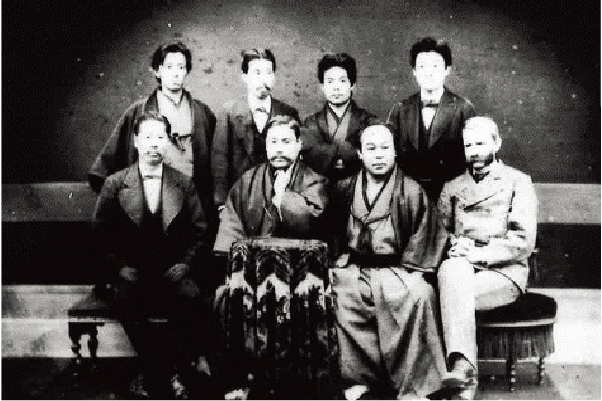
Iwasaki Yatarō and Mitsubishi Executives, circa 1877. Honda is in the back row, second from the left. Photo courtesy of the Mitsubishi Archives.
Honda Masajirō was the Mitsubishi Mail Steamship Company’s first Hong Kong Office General Manager.
Burke-Gaffney, Brian. 2009. Nagasaki: The British Experience, 1854-1945. Kent, [England]: Global Oriental.
CROSSROADS: A Journal of Nagasaki History and Culture
Brian Burke-Gaffney, Nagasaki Institute of Applied Science, and Lane R. Earns, University of Wisconsin Oshkosh. Last updated: December 13, 2003.
ON THE JAGGED SHORES OF JAPAN: The Story of the Walker Brothers http://www.uwosh.edu/faculty_staff/earns/walker.html
MacKeown, P. Kevin. 2020. A Stormy Petrel: The Life and Times of John Pope Hennessy. Hong Kong: City University of Hong Kong Press.
Ng, Benjamin Wai-ming. 2005. “Making of a Japanese Community in Prewar Period (1841–1941).” In Foreign Communities in Hong Kong, 1840s-1950s, edited by Cindy Yik-yi Chu. Palgrave Macmillan.
Perry, John Curtis. 1966. “Great Britain and the Emergence of Japan as a Naval Power.”
Monumenta Nipponica 21, No. 3/4: 305-321.
Wray, William D. 1984. Mitsubishi and the N.Y.K., 1870-1914: Business Strategy in the Japanese Shipping Industry. Cambridge, Mass.: Council on East Asian Studies, Harvard University: Distributed by Harvard University Press.
Wray, William D. 1998. “National Alliances and Global Webs: The Internationalization of Japanese Shipping.” In Global Markets: The Internationalization of the Sea Transport Industries Since 1850, edited by David J. Starkey, and Gelina Harlaftis, 81-102. St. John’s, Newfoundland: International Maritime Economic History Association.
Yonekura, Seiichiro, and Hiroshi Shimizu. 2012. “Entrepreneurship in Pre–World War II Japan: The Role and Logic of the Zaibatsu.” In The Invention of Enterprise: Entrepreneurship from Ancient Mesopotamia to Modern Times, edited by David S. Landes, Joel Mokyr, and William J. Baumol, 501-526. Princeton: Princeton University Press.
The China Mail, October 12, 1879.
The China Mail, November 13, 1879.
Hong Kong Daily Press, November 4, 1880.
Births and Deaths General Register Office, Immigration Department, Government of the Hong Kong Special Administrative Region.