 S35
S35
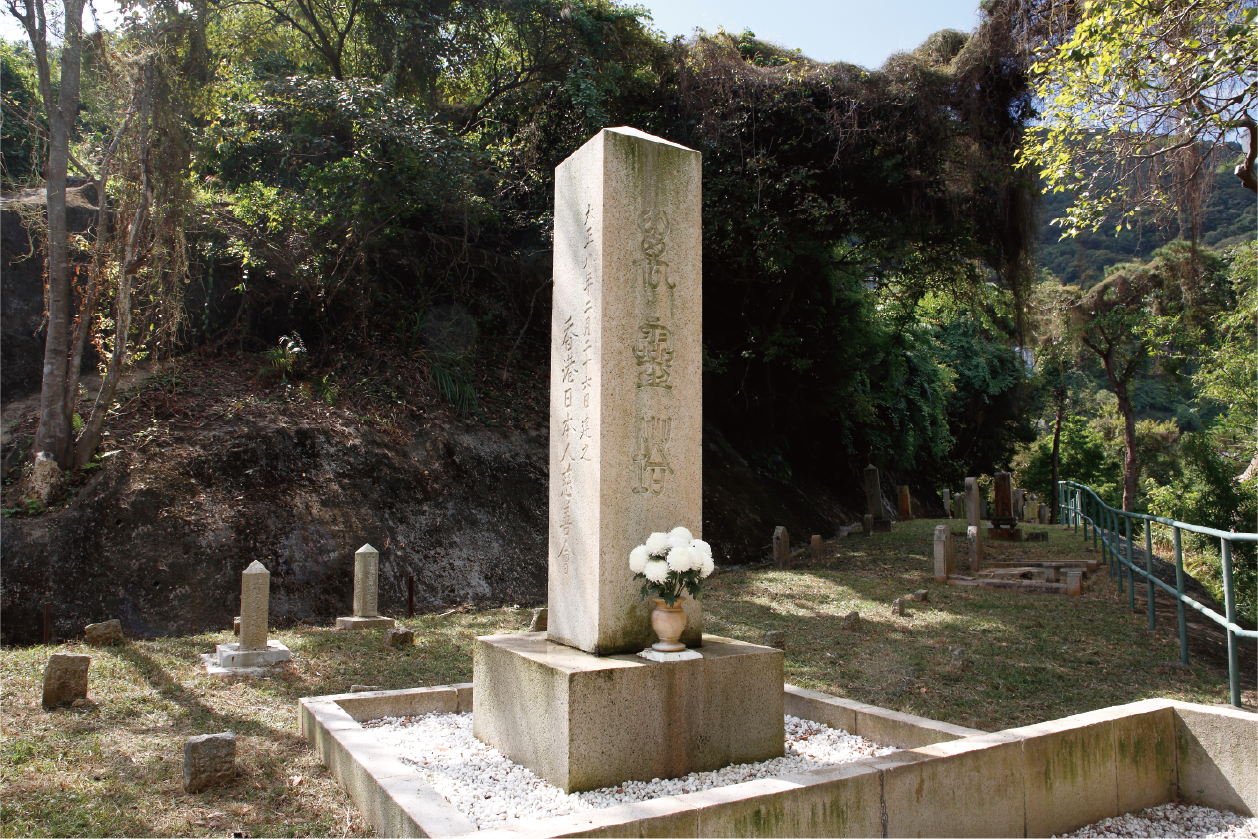
The focal point of the Japanese section of the Hong Kong Cemetery is a grand monument dedicated to the victims of the February 26, 1918, Happy Valley Racecourse fire: the Memorial to Ten Thousand Souls. Over 600 people perished in the fire, including at least 13 Japanese. First unveiled near the Japanese Crematorium in So Kon Po on February 26, 1919, the monument was moved to its present location in 1982. The tall rectangular pillar is shaped like an obelisk and is engraved on one side with three characters written in the style of an ancient Chinese seal. The calligraphic inscription, which can be translated as “memorial to ten thousand souls,” is the work of ŌTANI Kōzui (1876-1948), the 22nd Abbot of the Jyōdoshinshū Hongwanji, commonly known as Nishi Hongwanji, a major school of Japanese Buddhism.
In 1868, the newly installed Meiji government issued a series of decrees ordering the dissociation of Shintō and Buddhism, which negatively impacted Japanese Buddhists. This, together with a desire to demonstrate that Buddhism was the equal of other religions and respond to the sudden influx of Christian missionaries, prompted Ōtani’s father, the 21st Abbot, to institute a number of much- needed reforms. He reviewed the Nishi Hongwanji organisational structure, updated the educational system to include the study of geography and English, and encouraged overseas travel to learn from other faiths and philosophical traditions, and promote a more modern image of Japanese Buddhism.
Ōtani received both traditional Buddhist and modern educations. He shared his father’s outlook and travelled widely. He spent two and a half years in London, arriving in the city in March 1900.
During his stay, he published an account of his travels in China, which led him to be made a Fellow
of the Royal Geographical Society. In Japan, he is best known for the three expeditions he organised and financed to explore Central Asia and India between 1902 and 1914, with the purpose of excavating Buddhist sites and collecting archaeological material. Keen to spread the Nishi Hongwanji message, Ōtani actively supported the setting up of Japanese overseas resident associations and the establishment of temples. His HK$500 donation made during a visit to Hong Kong in 1899 financed the creation of the city’s Nippon Club.
Hong Kong’s Hongwanji centre officially opened in February 1907. However, as early as 1900, the Nishi Hongwanji priest TAKATA (sometimes transcribed as TAKADA) Seigan was engaged in missionary work in Hong Kong. He is credited with opening a small operation at 117 Wanchai Road where he taught history and the philosophy of Mencius to children. This would later evolve into a Japanese primary school, the management of which was eventually taken over by the Japanese Benevolent Society.
In addition to performing Buddhist rituals, the Nishi Hongwanji set up a woman’s group, and offered cooking and knitting classes to its followers. Among them was UMETSU Sami, who passed away on April 10, 1910, aged 42, and is buried in the Hong Kong Cemetery. Her posthumous name—or kaimyō—starts with “Shakuni Myōshin,” in line with Hongwanji tradition. Kaimyō are assigned to the deceased for use in the afterlife, and their meaning is closely connected to a person’s accomplishments and rank in society. Originally from the Shimabara Peninsula near Nagasaki, Umetsu may well have first come to Hong Kong as a karayuki-san. An English inscription at the base of her tombstone gives her occupation as “nurse,” though she may also have been a “nanny.” Several of the early Japanese graves have bilingual engravings, a meaningful testament to the intersections between the Japanese and other communities in Hong Kong at that time.
It is believed that the majority of the early Japanese graves in the Hong Kong Cemetery contain bones, despite a growing preference among the Japanese community for cremation. Japanese Buddhism advocated cremation, which it saw as purifying the body of the deceased, and, unlike bones, the ashes of deceased loved ones could be transported back to Japan. However, Confucians and the members of several Christian faiths, Catholics in particular, were vocal opponents of this practice. With the number of Japanese residents in Hong Kong rising at the start of the twentieth century, the government agreed in 1911 to grant a lot of 30,000 square feet in So Kon Po (Inland Lot 1879) to the “Japanese Consul for the Japanese Community as a site for a Crematorium.” A second lot of 75,170 square feet (Inland Lot 1920) was granted in 1912 as a site for a Buddhist Temple, and there is evidence that the Nishi Hongwanji, working with a close collaborator of Ōtani, the architect ITŌ Chūta (1867–1954), drew up plans for a Hong Kong Betsuin (branch temple). Due to a lack of funds, the temple was never built, though the Nishi Hongwanji did perform ceremonies and death rituals at the Crematorium. The Memorial to Ten Thousand Souls was erected next to the Japanese Crematorium in February 1919 and, though the Crematorium itself was demolished well before that, the Memorial remained there until 1982.
The Japanese community is responsible for the beautiful cherry blossom trees that can be found dotted along the path leading to the Japanese section of the Hong Kong Cemetery. In August 2002, the Kabuki actor ICHIMURA Manjiro (1949-) travelled to Hong Kong for two performances at the Hong Kong Cultural Centre. He and his wife Kiyoko suggested planting trees in locations important to the Japanese community, including the Cemetery. Arrangements were made with the support of the Kasumi Kaikan in Tokyo, an association that promotes traditional Japanese culture, and a total of 25 trees of the Kawazu-zakura variety were brought to Hong Kong from Shizuoka prefecture. On February 14, 2004, Japanese Consul-General YOKOTA Jun and his wife officiated at the planting of fourteen trees in the Cemetery. Of the original fourteen, six remain and continue to greet visitors with their bright pink blossoms every spring.
The Memorial was moved to its present location in 1982.
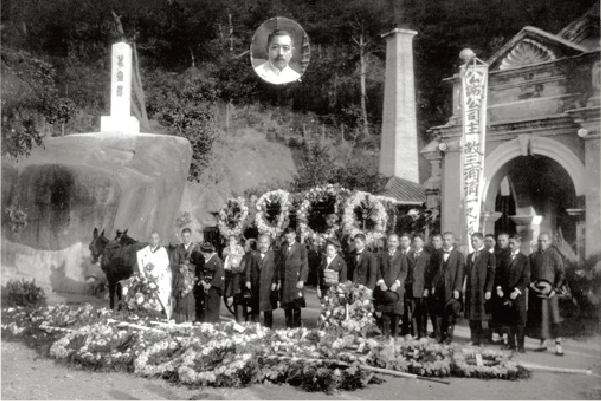
This image of Miura Seiichi’s funeral in 1920 depicts the Memorial in its original location next to the Japanese Crematorium in So Kon Po. Photo courtesy of Mr. Ko Tim-keung.
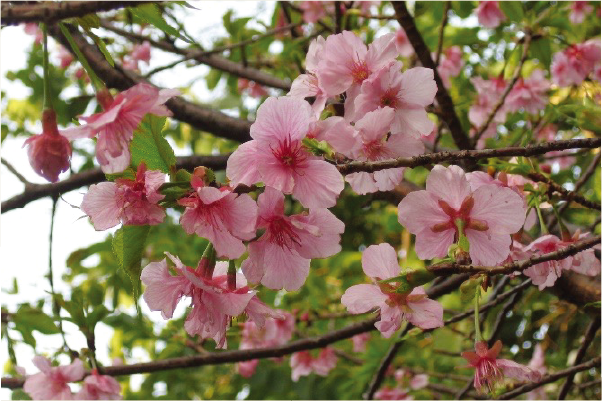
Fourteen cherry blossom trees were planted in the Cemetery in 2004, of which six remain.
Galambos, Imre, and Kitsudō Kōichi. 2012. “Japanese Exploration of Central Asia: The Ōtani Expeditions and their British Connections.” Bulletin of the School of Oriental and African Studies 75, No. 1: 113-134.
Hayes, James W. 1983. “So Kon Po: Notes for the Visit Made by Members of the Society, 26th November 1983.” Journal of the Hong Kong Branch of the Royal Asiatic Society 23: 12-17.
Hiatt, Anna. 2015. “The History of Cremation in Japan.” JSTOR Daily (September 9, 2015):
https://daily.jstor.org/history-japan-cremation/
Jaffe, Richard M. 2006. “Buddhist Material Culture, ‘Indianism,’ and the Construction of Pan-Asian Buddhism in Prewar Japan.” Material Religion 2, No.3: 266-292.
Ko, Tim-Keung. 2001. “A Review of Development of Cemeteries in Hong Kong: 1841-1950.”Journal of the Royal Asiatic Society Hong Kong Branch 41: 241-280.
Lim, Patricia. 2011. Forgotten Souls: A Social History of the Hong Kong Cemetery. Hong Kong: Hong Kong University Press.
Mak, Bill M. 2015. “The Career of Utsuki Nishū in Hong Kong During the Japanese Occupation Period (1941-1945).” Journal of the Hong Kong Branch of the Royal Asiatic Society 55: 57-82.
Ōtani, Kosui. 1906. “The Japanese Pilgrimage to the Buddhist Holy Land: A Personal Narrative of the Hongwanji Expedition of 1902-03.” The Century Illustrated Monthly Magazine 72 (October 1906): 866-878.
Prideaux, Eric. 2002. “The Long Goodbye.” The Japan Times (October 27, 2002).
Smith, Carl T. 1983. “Notes on the So Kon Po Valley and Village.” Journal of the Hong Kong Branch of the Royal Asiatic Society 23: 12-17.
Tankha, Brij. 2018. “Exploring Asia, Reforming Japan: Ōtani Kōzui and Itō Chūta.” In Japan on the Silk Road: Encounters and Perspectives of Politics and Culture in Eurasia, edited by Selçuk Esenbel. Leiden and Boston: Brill.
Hong Kong Government Administrative Reports for the Year 1911 Report of the Director of Public Works, Appendix P, page 6.
Hong Kong Government Administrative Reports for the Year 1912 Report of the Director of Public Works, Appendix P, page 7.