 S6
S6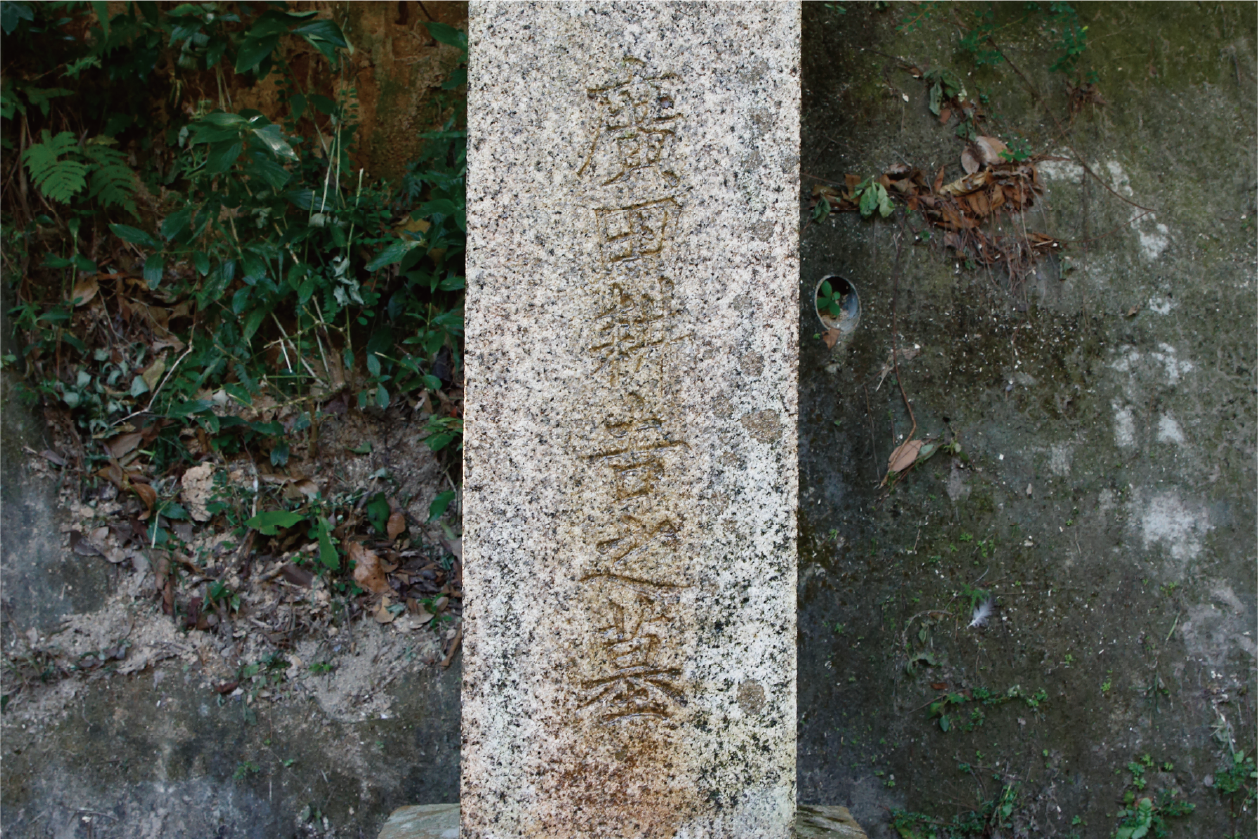
The Yokohama Specie Bank (YSB) opened its Hong Kong office on September 22, 1896, with the aim of advancing Japan’s adoption of the gold standard. Amongst its first employees was HIROTA Kōkichi, a native of Ishikawa prefecture. Hirota initially worked as a clerk under NABEKURA Nao, before being promoted to sub-agent, or deputy general manager. He passed away on July 30, 1900, at the age of 29. Another young YSB employee, NAKASONO Shūgo, who died of the plague at the Government Civil Hospital on June 18, 1906, at the age of 27, is buried nearby.
The Meiji era’s (1868-1912) modernisation drive included updating Japan’s banking and financial sectors in order to compete with western powers on equal terms. Prior to 1868, the country had a quasi-banking system in place, but rice was still widely used for the payment of taxes, for example. The opening up of Japan to overseas trade beyond a couple of its ports demanded that it rapidly institute a modern banking system in order to avoid falling victim to the unequal currency exchange practices that had already led to the depletion of the country’s gold reserves during the final years of the Tokugawa Shogunate.
The Meiji government inherited a multitude of gold, silver and copper coinage—or specie—along with a vast array of different banknotes, with almost every domain issuing their own version.
Initiatives to standardise the Japanese currency included replacing the ryo with the yen in 1869 and the opening of the Osaka Mint in 1871. Initially, with the Mexican silver dollar recognised as the main form of payment in most treaty ports, the government had planned to base its new currency on the silver standard. However, after observing the transitioning of several major western powers to gold, the Japanese government officially adopted the gold standard with an Imperial Ordinance in May 1871. For a variety of reasons, not least a shortage of the metal, the adoption of the gold standard in Japan would remain nominal until 1897.
The modernisation of the banking system continued with the drafting of the National Bank Decree in 1872, and the establishment of Japan’s first national bank, Daiichi Kokuritsu Ginkō, shortly thereafter. The Tokyo Stock Exchange was established in June 1878. Despite these initiatives, a large amount of paper money, often in the form of inconvertible banknotes issued by both official and quasi-banking institutions, remained in circulation. This state of affairs led to the founding of the Yokohama Specie Bank (Yokohama Shōkin Ginkō, YSB), which opened its doors in February 1880. The YSB’s primary task was to act as a collection point for silver and gold specie or bullion from both within and outside of Japan, which could then be circulated in a more controlled way and used as the basis for the country’s paper currency. The regulation of note issue was to be the responsibility of the country’s new central bank—the Bank of Japan, founded in 1882 and modelled on the Bank of Belgium.
Despite some initial hiccups, YSB proved to be extremely successful in capitalising on Japanese exports of silk and tea, in particular, to secure a net import of specie through the use of discounted foreign bills of exchange, for example. YSB collected payment for exports in foreign currency through the offices it had established in New York (1880), London (1881), Lyons (1882), and San Francisco (1886). The London office—branch from 1894 onwards—played a vital role in YSB’s endeavours to remit specie to Japan. It was into YSB’s London branch that China’s indemnity of 360,000,000 yen was paid in British pound sterling. This significant payment was made by China under the terms of the Treaty of Shimonoseki that ended the Sino-Japanese War in 1895. It amounted to three times Japan’s national revenue, and was what finally enabled Japan to adopt the gold standard, both officially and in practice, on October 1, 1897. It also led to the Bank of England authorising YSB to open an account, thereby signalling YSB’s admission to the international banking arena and recognising Japan as a commercial rival on the world stage.
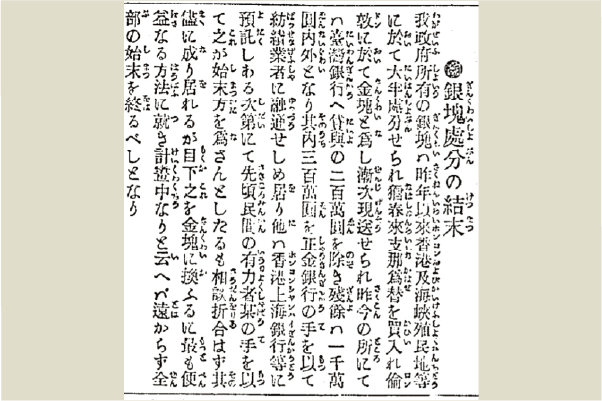
YSB opened its Hong Kong office on September 22, 1896. Chinese merchants predominantly used silver for trade, and YSB played an important role in collecting and withdrawing Japanese silver specie from circulation through various financial transactions. It then melted them into bullion, which could be used to buy gold for the Japanese government or sold on. With the value of silver prone to major fluctuations, the Hong Kong YSB employees had to keep a keen eye on gold and silver prices, and maintain a delicate balancing act between buying and selling the precious metals. According to YSB archival records, its Hong Kong office held 500,000 dollars in silver assets when it opened in 1896, but this amount had risen to 2,390,000 dollars just three years later, a testament to the Hong Kong team’s hard work and banking skills. The Hong Kong office was promoted to a branch in 1900 and, its mission successfully accomplished, it handed over the collection and dealing of silver to the Shanghai YSB branch in May 1906.
Hirota was one of YSB’s first employees in Hong Kong, working as a clerk before his promotion to sub-agent or deputy general manager. His name appears twice on Hong Kong’s list of jurors, in 1898 and 1900. Since not being “ignorant of the English language” was a prerequisite for inclusion on the jurors’ list, we can safely assume that he had some knowledge of English. This would have been necessary to facilitate communications with his counterparts at other major banks in the territory dealing in foreign currencies, including the Hongkong and Shanghai Banking Corporation. His “abode” in the 1898 list is given as a house on Robinson Road, whereas by 1900 he had moved to a residence on Peak Road, possibly as a result of his promotion.
YSB’s Hong Kong office was originally located at 6 Praya Central (today’s Des Voeux Road Central) and Ice House Street. From 1901 onwards, the Hong Kong Directory lists YSB’s address as Prince’s Building. This brand new four-storey, fully electrified block was built for Sir C. Paul Chater and Sir Hormusjee N. Mody. Its construction was made possible by the Central Praya Land Reclamation that, upon its completion in 1904, added approximately 24.3 hectares of new land to the Central waterfront.
Japan effectively departed from the gold standard in 1917, briefly returning to it for nearly two years from 1930 to 1931 mainly as a consequence of the Wall Street Crash of 1929. YSB’s assets were frozen or confiscated under the orders of the Supreme Commander for the Allied Powers, General Douglas MacArthur, after the Second World War. YSB was eventually reorganised as the Bank of Tokyo in December 1946, one of the precursors of what is today the Mitsubishi UFJ Financial Group, Inc (MUFG). The Bank of Tokyo opened its Hong Kong branch at 1 Duddell Street on October 16, 1953.
An article detailing the role played by YSB’s Hong Kong office in the collection and withdrawal of silver specie from circulation was published in the Tokyo Asahi Shimbun on April 20, 1899.
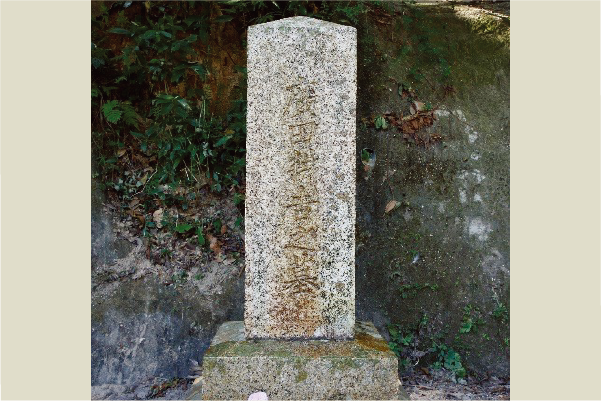
Hirota was one of YSB’s first employees in Hong Kong.
Hongkong Land at 125. Published in 2014. https://hklandblob.blob.core.windows.net/assets/125_anniversary/mobile/index.html#p=1
MUFG (Mitsubishi UFJ Financial Group): History Before 2005: https://www.mufg.jp/english/profile/overview/history/before2005/index.html
Tamaki, Norio. 1995. Japanese Banking: A History, 1859-1959. Cambridge: Cambridge University Press.
Tamaki, Norio. 1990. “The Yokohama Specie Bank: A Multinational in the Japanese Interest 1879- 1931.” In Banks as Multinationals, edited by Geoffrey Jones, 191-216. London: Routledge.
“Progress of Hong Kong. Prince’s Buildings.” South China Morning Post, September 30, 1904.
The Hongkong Directory and Hong List for the Far East. 1900. Published by the Hong Kong Daily Press Office.
The Hongkong Directory and Hong List for the Far East. 1901. Published by the Hong Kong Daily Press Office.
The Hong Kong Government Gazette, 26th February 1898. The Hong Kong Government Gazette, 28th February 1900.
Hong Kong Ordinance No. 18 of 1887:
https://oelawhk.lib.hku.hk/archive/files/2164c1b23981c8313f8ea88b9a05b0d5.pdf
Births and Deaths General Register Office, Immigration Department, Government of the Hong Kong Special Administrative Region