 S27
S27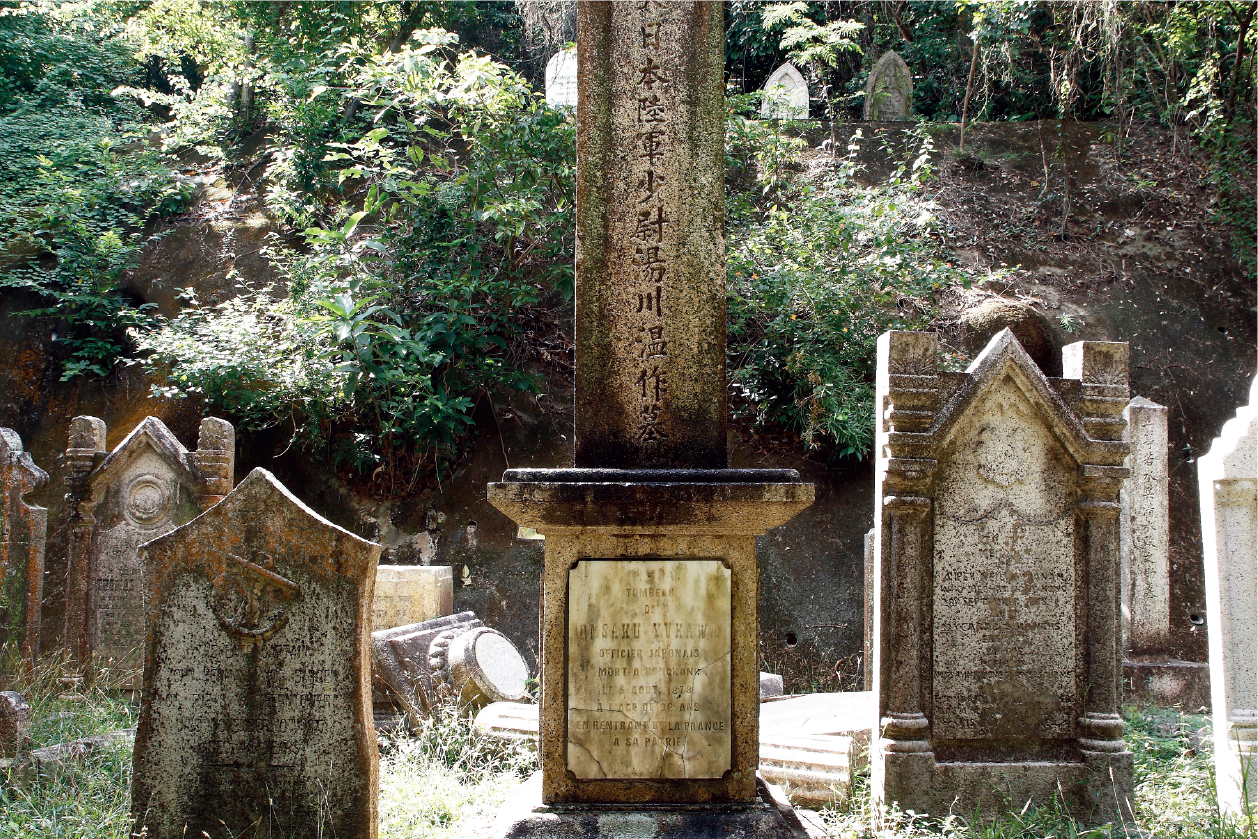
The oldest identifiable Japanese grave in the Hong Kong Cemetery is that of YUKAWA Onsaku. Born in the Chōshū domain (now part of Yamaguchi prefecture) in the mid-1850s, Yukawa was awarded a scholarship to travel to France for military training in 1872. Yukawa was on his way back to Japan via Hong Kong when he succumbed to consumption on August 5, 1878, aged 22.
The Meiji era (1868-1912) marked the beginning of a period of great change and opening up of the country. Japan established relationships with several European powers with the aim of modernising the Imperial Japanese Army. Examples of these contacts include the IWAKURA Tomomi Mission to the U.S. and Europe (1871-1873) and the second French military mission to Japan (1872-1880).
Records show that in the autumn of 1872 there was a total of 58 Japanese students in France, including eight from the Chōshū domain. There is evidence that Yukawa received some French language training prior to his departure. He and several fellow students sailed from the port of Yokohama on November 12, 1872, aboard the Messageries Maritimes steamship Phase bound for Hong Kong. He arrived in the city on November 18 and transferred to the Provence for the remaining portion of the voyage, finally landing in Marseille, France, on December 16, 1872.
Yukawa spent close to six years in France, attending a number of French academic institutions before entering the prestigious École Polytechnique in Paris in 1877. Unfortunately, he fell ill and was unable to complete his first year, deciding instead to return to Japan. He and two companions, HIRO Toraichi and KOSAKA Chihiro, left Marseille for Yokohama on the Djemnah on June 30, 1878. The Messageries Maritimes ship made a scheduled stopover in Hong Kong on August 4 and Yukawa passed away just a day later.
Yukawa’s grave lies outside of the main Japanese section of the Hong Kong Cemetery, which was officially established in 1845. The tombstone includes a tall rectangular pillar (in this case an obelisk) and bears inscriptions in Chinese characters (kanji). This is in line with traditional Japanese Buddhist burial practices. Unusually, however, the lower part of the tombstone bears an epigraph in French. Yukawa’s rank is listed as that of second lieutenant, an honour awarded posthumously. His interment was arranged by Hong Kong’s newly established Japanese Consulate, which opened its doors on April 20, 1873, and was attended by a consular official, TERADA Ichirō.
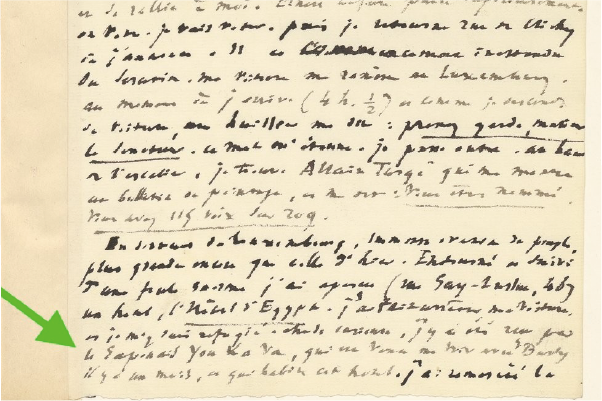
A Japanese scholar has posited that Yukawa met the acclaimed French politician and author Victor Hugo during his time in Paris. They may have been introduced by the art critic Phillippe Burty. Hugo and Burty were well acquainted and shared an interest in Japanese art, which had become popular in France following the 1867 Exposition Universelle in Paris. Burty was a keen collector of ukiyo-e woodblock prints and is credited with coining the term “Japonisme.” An entry in Hugo’s diary, dated January 30, 1876, reads, “A Japanese man, You Ka Va, welcomed me in. Burty brought him to see me a month ago, and he lives in the hotel.” It is believed that Hugo, seeking relief from the crowds following his election to the Senate of the Third Republic, found refuge at l’Hôtel d’Égypte, 46 Rue Gay-Lussac, where Yukawa was staying, and encountered him there.
The Meiji Era and the Opening of Japan
The Meiji era (1868-1912) marked the beginning of a remarkable period of modernisation and opening up of Japan. During the rule of the Tokugawa Shogunate (1600-1868), Japan’s ports were closed to all but a few, predominantly Dutch and Chinese, traders, and the country lagged behind the West in its knowledge of science and technology. The tentacles of European and American imperialism eventually reached Japan on July 8, 1853, when Commodore Matthew Perry of the U.S. Navy sailed into the harbour of present-day Tokyo with a squadron of warships and a letter from the U.S. President that demanded the opening of Japan’s ports. This incursion led to the Convention of Kanagawa in 1854, and the eventual downfall of the Tokugawa Shogunate and establishment of the Meiji government in 1868.
The Meiji government launched a series of initiatives aimed at bridging the country’s technological gap with the West and safeguarding its political autonomy. These included abolishing feudal domains, setting up a modern political system, and reforming its institutions. It hired over 2,000 foreign engineers and teachers and led several overseas missions to more technologically advanced countries, including Britain, the U.S, and France. Japanese students were sent overseas between 1871 and 1873 to various training academies. The Ministry of Education was established in 1871 and the education system reformed to develop human capital. Nine Imperial Universities were created in 1886, in addition to Keio University (founded in 1858) and Hitotsubashi University (founded in 1875). Both Keio and Hitotsubashi were instrumental in providing the necessary training in economics, accounting and management required for the country’s new breed of entrepreneurs.
The entry in Victor Hugo’s diary, dated January 30, 1876, which details his encounter with “You Ka Va.” Original held by the Bibliothèque nationale de France.
Yukawa’s grave, with inscriptions in Japanese and French.
Bibliothèque nationale de France. Fonds Victor Hugo. III — CARNETS. 1er janvier-31 décembre 1876. Page 15r. https://gallica.bnf.fr/ark:/12148/btv1b530382945/f33.item
Giunta, Léna. 2017. “La presence francaise et la diffusion du francais au Japon au XIXeme siècle.” Journal of Liberal Arts 143 (The Liberal Arts Research Center, The School of Political Science and Economics, Waseda University): 17-42.
Ichikawa, Shinichi. 2003. “La Mission Iwakura (1871–1873) et la France: ce que virent en Europe les Japonais de l’époque Meiji.” Bulletin of the Institute for Mediterranean Studies (in French).Shinjuku, Tokyo: Institute for Mediterranean Studies, Waseda University.
Lim, Patricia. 2011. Forgotten Souls: A Social History of the Hong Kong Cemetery. Hong Kong: Hong Kong University Press.
Maejima, Michiko. 2014. “Édifier et équiper les bases de l’armée japonaise: Transferts de technologie, France-Japon 1868-1930.” Doctoral thesis for the Conservatoire national des arts et métiers (CNAM).
https://tel.archives-ouvertes.fr/tel-01124311/file/2014CNAM0912_annexe.pdf
Nicolson, Ken. 2010. The Happy Valley: A History and Tour of the Hong Kong Cemetery. Hong Kong: Hong Kong University Press.
Perry, John Curtis. 1966. “Great Britain and the Emergence of Japan as a Naval Power.”
Monumenta Nipponica 21, No. 3/4: 305-321.
Shingo, Fukushima. 1965. “The Building of a National Army.” The Developing Economies 3, No. 4 (December): 516-539. https://www.ide.go.jp/library/English/Publish/Periodicals/De/pdf/65_04_08.pdf
Yonekura, Seiichiro, and Hiroshi Shimizu. 2012. “Entrepreneurship in Pre–World War II Japan: The Role and Logic of the Zaibatsu.” In The Invention of Enterprise: Entrepreneurship from Ancient Mesopotamia to Modern Times, edited by David S. Landes, Joel Mokyr, and William J. Baumol, 501-526. Princeton, NJ: Princeton University Press.
The China Mail, November 18, 1872.
Hong Kong Daily Press, August 5, 1878.